
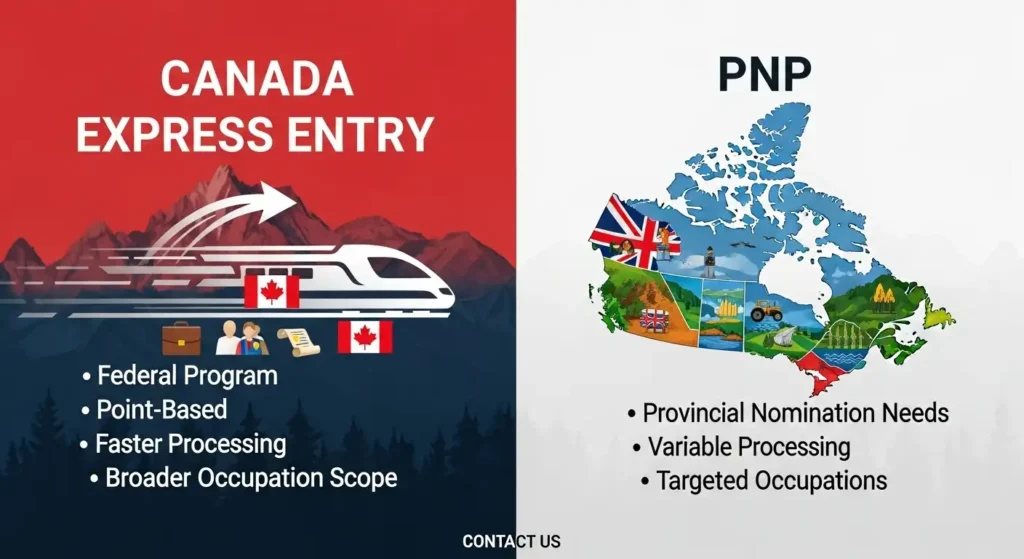
Many skilled professionals planning to immigrate to Canada often wonder about the difference between the Express Entry System and the Provincial Nominee Program (PNP).
Both pathways are designed to attract skilled workers who can contribute to Canada’s economy, but they differ in management, eligibility, and post-immigration rights.
Below is a detailed comparison between the two systems to help you identify which one may be better suited to your profile.
What Is the Express Entry Program?
The Express Entry system is a federal immigration management system run by Immigration, Refugees and Citizenship Canada (IRCC).
It was introduced in 2015 to streamline applications for permanent residence (PR) under three main economic immigration programs:
- Federal Skilled Worker Program (FSWP)
- Federal Skilled Trades Program (FSTP)
- Canadian Experience Class (CEC)
Applicants create an online profile and are assessed based on the Comprehensive Ranking System (CRS), which assigns points for factors such as:
- Age
- Education level
- Skilled work experience
- English or French language proficiency
- Adaptability and job offers
Those with the highest CRS scores receive an Invitation to Apply (ITA) for permanent residence.
What Is the Provincial Nominee Program (PNP)?
The Provincial Nominee Program (PNP) is managed by individual provinces and territories in Canada, each having its own immigration streams designed to meet local labour market needs.
A PNP allows provinces to nominate candidates for PR who:
- Possess skills or work experience in occupations that are in demand in that region
- Have a valid job offer from a local employer
- Have studied, lived, or worked in that province previously
There are two types of PNP streams:
- Enhanced PNP streams, linked to Express Entry (nomination adds +600 CRS points)
- Base PNP streams, independent of Express Entry and processed separately through IRCC
What Are the Key Differences Between Express Entry and PNP?
1. Authority and Control
- Express Entry is managed by the federal government (IRCC).
- PNPs are operated by , such as Ontario, Alberta, or British Columbia.individual provinces and territories
Each province designs its own selection criteria based on its labour and economic priorities.
2. Selection Priorities
- Express Entry focuses on federal criteria such as language ability, education, and skilled experience.
- PNP prioritizes candidates who align with provincial labour demands or have a valid job offer.
If a candidate has a lower CRS score or lacks advanced language proficiency, applying through a PNP can improve their chances of obtaining PR.
3. Point Allocation System
- Express Entry uses the Comprehensive Ranking System (CRS) to score and rank profiles in the pool.
- PNPs award nominations to candidates with skills, job offers, or qualifications relevant to their regional needs.
A provincial nomination automatically adds 600 CRS points, guaranteeing an invitation under Express Entry.
4. Right to Mobility and Settlement
- Express Entry PR holders can live and work anywhere in Canada, except Quebec (which has its own immigration system).
- PNP PR holders are expected to reside in the nominating province for a minimum period.
- Moving prematurely to another province without valid reasons may affect the nomination or PR status.
- Moving prematurely to another province without valid reasons may affect the nomination or PR status.
However, relocation is permitted later, as PR holders ultimately have freedom of movement under the Canadian Charter of Rights.
5. Processing Time
- Express Entry: On average, most applications are processed within six months or less.
- PNP: Processing varies depending on the province and stream.
- Enhanced PNPs (linked to Express Entry): approximately 6–8 months
- Base PNPs (paper-based): up to 18–21 months
- Enhanced PNPs (linked to Express Entry): approximately 6–8 months
6. Cost of Application
- Express Entry: The estimated total cost (including documentation, fees, and settlement proof) starts from CAD 13,000 for a single applicant.
- PNP: Each province charges its own nomination fee, generally ranging between CAD 250–1,500, in addition to federal fees.
Which Is Better: Express Entry or PNP?
The better option depends entirely on the applicant’s personal profile, CRS score, job status, and province of interest.
Express Entry May Be Better If:
- You have a high CRS score and strong English/French language proficiency.
- You want faster processing and freedom to settle anywhere in Canada.
- You possess a recognized degree, foreign work experience, or Canadian experience.
PNP May Be Better If:
- Your CRS score is below the typical Express Entry cut-off.
- You have a job offer or ties to a specific province.
- You work in a high-demand occupation identified by a province.
- You prefer to settle in a region offering targeted employment and settlement incentives.
Summary of Differences Between Express Entry and PNP
| Criteria | Express Entry | Provincial Nominee Program |
| Managing Authority | Federal (IRCC) | Individual Provinces/Territories |
| Key Selection Basis | CRS score (age, education, experience, language) | Regional labour market needs and job offers |
| Processing Time | Around 6 months | 6–21 months depending on stream |
| Freedom to Work | Anywhere in Canada (except Quebec) | Primarily in nominating province |
| Provincial Involvement | Not required | Mandatory for nomination |
| Cost Range | ~CAD 13,000 (average) | CAD 250–1,500 provincial fee + federal fees |
| Points Boost | None unless nominated | +600 CRS points for Express Entry-linked streams |
Final Thoughts
Both Express Entry and Provincial Nominee Programs are effective pathways to obtain Canadian permanent residence.
While Express Entry is faster and more flexible, PNPs are more targeted and accessible for candidates with lower CRS scores or provincial ties.
Choosing between the two depends on your individual circumstances, including language proficiency, career background, adaptability, and where you intend to live in Canada.
Applicants are encouraged to:
- Evaluate their CRS score before applying.
- Research provincial in-demand occupations and eligibility streams.
- Ensure financial readiness for settlement and documentation costs.
With the right preparation, both pathways can lead to a successful and permanent future in Canada.